Plants Wilting Despite Watering in the Heat? Why Drip Coverage Is the Problem
August 19, 2026
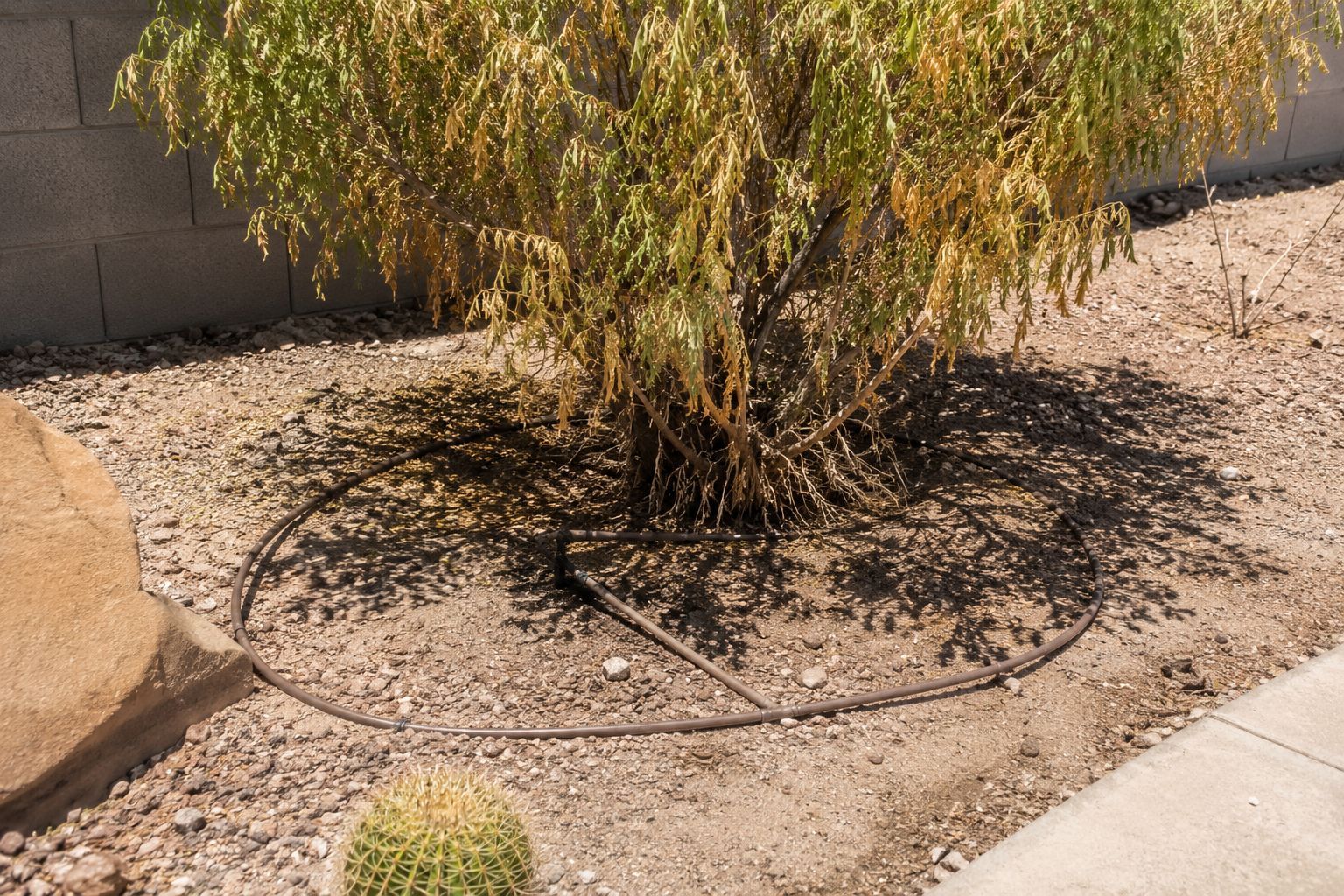
Quick Answer: When a plant wilts in the heat even though the drip system ran on schedule, the emitters are usually watering the wrong spot rather than failing outright. Roots grow outward as a plant matures, and by the time a shrub or tree has doubled in size, its active root zone can sit well past where the original emitter was placed at planting. In peak Sonoran Desert summer, trees can need water every four to seven days just to keep pace with evapotranspiration, so a coverage gap that barely mattered in April becomes obvious wilting by July. Fixing it means moving or adding emitters to match the plant's current dripline, not just running the zone longer.
You water on schedule. The controller clicks on every other morning, the zone runs its full cycle, and by every measure the system is doing its job. Yet that same shrub by the patio droops by two in the afternoon, and the tree near the fence line has leaves curling at the edges even though the ground under it feels damp. It's confusing, because nothing about the schedule changed and nothing looks obviously broken. The water is going somewhere. It just may not be going where the plant needs it anymore.
The Emitter Doesn't Move When the Plant Does
A drip emitter waters one fixed point in the soil. When a nursery plant goes into the ground, that emitter sits close to the trunk or stem because that's where the roots are at the time. But roots don't stay put. As a shrub or tree grows, its feeder roots, the ones actually pulling in water, spread outward and downward, chasing moisture and following the plant's expanding canopy. Within a couple of seasons, the roots doing the real work of hydrating the plant can be sitting a foot or more from where that original emitter still drips.
This is exactly the gap the University of Arizona Cooperative Extension flags in its guidance on drip irrigation design: as plants grow, emitters need to move out to the edge of the canopy, the dripline, where the active roots are taking up water, and the system needs re-evaluation for whether it needs more emitters or higher-output ones to keep up. Most systems never get that adjustment. They get installed once, at planting, and left alone for years while the plants around them keep growing.
A young tree and a mature one need different coverage entirely.
A tree's root zone typically spreads two to three times wider than its canopy once it's established, extending well past where a young sapling's roots once were. One or two emitters that adequately watered a five-gallon shrub at installation are nowhere near enough for the same plant three years later, no matter how long the zone runs each morning.
Heat Turns a Small Gap Into a Visible Problem
A slightly undersized watering pattern can go unnoticed for months. Then summer hits, and the same plant that looked fine in March is wilting by June. That's not a coincidence.
Heat speeds up how fast a plant loses water through its leaves and how fast the soil around it dries out, a combined process called evapotranspiration. The University of Arizona Cooperative Extension notes that during the hottest part of summer, trees may need irrigation every four to seven days just to stay ahead of it, compared with intervals stretching four to ten weeks in the cooler months. Palms follow a similar pattern, often needing water every two to four weeks in summer versus every six to eight weeks in winter. When demand roughly quadruples and the coverage under the plant hasn't changed since installation, the margin for error disappears.
Wilting leaves, leaf edges that curl or brown, branch dieback, and a lack of new growth are the classic signs extension researchers point to when a plant is running short on water relative to what the heat is demanding from it. None of that means the irrigation system has failed. It usually means the system is delivering water to less soil than the plant's roots now occupy, and the heat is exposing exactly how much less.
Tip: Walk your yard midway through a watering cycle, not after it, and press a finger into the soil about six inches out from the plant's trunk at two or three points around its base. If the ground near the trunk is damp but the soil at the plant's actual dripline is bone dry, that's coverage lagging behind growth, not a scheduling problem.
What a Coverage Gap Actually Looks Like
A few patterns tend to show up specifically when the issue is where the water lands rather than whether the water is running at all.
One side of the plant looks worse than the other
If a shrub is wilting or thinning unevenly, more stressed on one side than the other, it often means the emitters sit closer to one side of the root ball, leaving the far side under-watered even while the near side gets plenty.
Older, established plants suffer more than younger ones nearby
A newer plant with an emitter still close to its smaller root zone can look fine while an older plant three feet away, whose roots outgrew its original layout years ago, struggles in the same zone on the same schedule.
The soil right under the emitter is wet, but a few inches out it's dust
Drip water moves through soil in a fairly narrow cone rather than spreading evenly, so a single emitter creates a localized wet spot. If the plant's roots have moved past that spot, that wet spot and the root zone are no longer the same place.
Symptoms show up first in the heat of the day and then persist into evening
A plant that perks back up by morning is usually dealing with ordinary daytime heat stress. One that's still drooping at dusk, well after the sun has dropped and temperatures have eased, is telling you the soil moisture at its roots just isn't there.
Matching Emitters to the Plant You Actually Have Now
Fixing a coverage gap isn't about running the zone longer. Extending run time with emitters in the wrong spot just wastes more water in the same undersized footprint.
Emitter output matters as much as placement
Standard drip emitters are rated at fixed flow rates, commonly around a half gallon, one gallon, two gallons, or four gallons per hour. A plant that's outgrown its original one-gallon-per-hour emitter may need two or three additional emitters at the new dripline, or a swap to a higher-output emitter, to deliver enough volume across a wider area in the same run time.
Micro-tubing has real length limits
The small feeder tubing that carries water from the main line out to an individual emitter is only meant to run a short distance, generally no more than about five feet, before pressure and flow start to suffer. A system that's been extended and patched over the years, adding new plants off the same line, can end up with tubing runs pushing well past what the design was ever meant to handle.
Trees need water spread across a wide area, not a single point
Because a tree's feeder roots occupy a wide, shallow band extending out past the drip line, watering it well usually means multiple emitters arranged in a ring around that zone, not one emitter close to the trunk. A single point of water can't wet enough soil to matter to a tree that size.
Warning: Don't respond to visible wilting by adding a lot more run time on the same emitters without checking placement first. Overwatering the same small zone repeatedly can saturate soil around the trunk while the actual root zone stays dry, which invites root rot and fungal problems on top of the water stress the plant was already showing. More time on a misplaced emitter doesn't fix a coverage gap. It just adds a second problem.
Coverage Changes Every Time You Add a Plant, Too
It's not only mature plants that outgrow their original layout. Every time a new plant goes into an existing bed, tapped off the nearest available drip line, it adds demand to a zone that was sized for what was there before. A bed that had three shrubs on a line built for three shrubs, and now has five, is asking the same pressure and flow to stretch further than it was designed for. That shows up as inconsistent watering across the whole zone, not just at the newest additions.
Seasonal maintenance is where this usually gets caught before it becomes a summer emergency. A system walked and checked before the heat sets in, rather than after plants start showing stress, gives you the chance to add emitters, adjust spacing, and rebalance a zone while the fix is simple instead of urgent.
Frequently Asked Questions
How do I know if my drip emitters are just too far from the plant?
Dig a small test hole about six inches from the emitter's drip point after the zone has run. If the soil there is dry while the area right under the emitter is wet, the water isn't reaching the plant's current root zone even though the system worked exactly as programmed.
Can I fix this by just running the system longer?
Not on its own. Longer run times push more water into the same spot the emitter already covers. If that spot no longer overlaps with the plant's roots, you're wasting water and risking a soggy patch near the trunk while the roots that need it stay dry.
Why did the same plant do fine last summer but struggle this year?
A plant's root zone keeps expanding every growing season, so a coverage gap that was small last year can be noticeably wider this year. Combine that with normal Sonoran Desert summer heat pushing water demand higher, and a plant that just barely got by last July can visibly wilt this one.
Is it better to add more emitters or move the existing ones?
It depends on how much the plant has grown. A modest shift outward might just mean repositioning the existing emitters to the new dripline. A plant that's grown considerably usually needs additional emitters spread around that wider area, since one point of water can't wet enough soil for a mature root zone.
Do all plants in my yard need the same emitter setup?
No. A young shrub, a mature tree, and a cactus all have different root structures and water needs, and lumping them onto identical emitter spacing on the same zone is a common reason some plants thrive while others nearby struggle.
How often should someone check emitter placement?
A seasonal check before summer heat arrives catches most coverage gaps before they cause visible stress. Any time you add new plants to an existing zone, or notice one plant consistently underperforming compared to its neighbors, that's also worth a look regardless of season.
Keeping Drip Coverage Aligned With Plant Growth
A drip system can operate perfectly while mature plants still struggle because irrigation coverage has not expanded with their roots. As shrubs and trees grow, emitters that once delivered water effectively may leave much of the active root zone dry. During intense Arizona heat, that mismatch becomes more noticeable as plants lose moisture faster. Checking emitter placement, output, soil moisture, and overall zone balance helps identify coverage gaps before prolonged stress causes browning, thinning foliage, or lasting plant damage.
With 14
years of experience, J Christie Landscape
helps properties throughout Litchfield Park and Goodyear, AZ maintain irrigation coverage that reflects how landscapes naturally change over time. Proper drip performance depends on more than a working controller or consistent watering schedule; it requires water to reach the roots currently supporting each plant. Periodic adjustments to emitter location, quantity, and flow allow irrigation systems to evolve alongside growing landscapes, helping plants remain healthier and better prepared for demanding summer conditions.